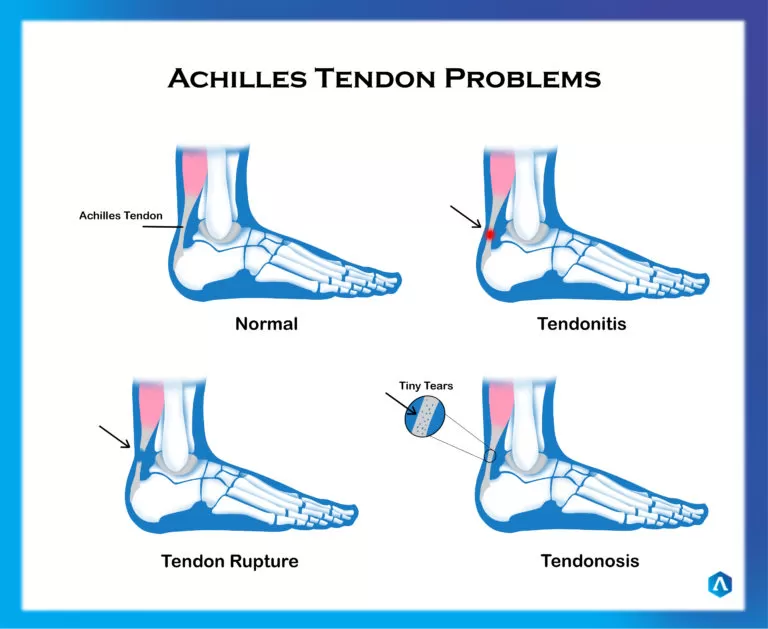
This is a relatively common condition that can affect anyone. It is also known as tendonitis, tendinopathy and tendonosis.
The Achilles tendon is the largest tendon in the body, connecting your calf muscles to your heel bone, and it plays a vital role in helping you walk, run, jump, stand, climb and get around. Athletes are prone to Achilles tendon pain due to overuse and degeneration. It is, therefore, a tendon that needs to be looked after, athlete or not.
The biomechanical profile of Achilles pain is similar to that of plantar fasciitis, as the foot pronates or supinates, causing a pull on the heel. If this continues, then tearing, inflammation and swelling can occur.
Causes
Causes are many.
This can be due to increased exercise activity, particularly if it is intense and sudden, or to tight calf muscles and taking on more exercise.
Also, bone spurs, which form when extra bone grows at the heel, can rub against the tendon, causing inflammation and pain.
Other causes include biomechanical anomalies, e.g., having one leg longer than the other, which creates more stress on the longer leg and its Achilles tendon.
Symptoms
If you are suffering from Achilles tendonitis, you may experience:
- General inflammation or irritation in the back of your leg down to your heel
- Morning pain and stiffness in the Achilles tendon
- Pain in the tendon or heel that gets worse when more active
- Severe pain following exercise, particularly the next day
- Tendon thickening and pain
- Bone spurs, which form when extra bone grows at the heel, are also known as insertional tendonitis.
- Continual swelling which worsens through the day and with activity.
It’s important to note that if you hear or feel a click in the back of your calf or heel, you might have torn your tendon. Seeking professional help immediately is advised.
Assessment
To confirm Achilles problems, book a full biomechanical assessment and a diagnostic and treatment program. In this situation, you may also be sent for an X-ray, an ultrasound and if needed, an MRI.
Dr Abbie Najjarine, principal at Dr Abbie Clinics, uses engineering principles to assess the body. Like any material, tendons have a yield point. He has applied this knowledge to help patients understand the body’s reaction to the activities we tend to inflict on it, and how this applies to a particular individual’s unique body structure and situation. If left untreated, Achilles problems can become severely debilitating.
Treatment
Most common treatments are non-surgical. At Dr Abbie Clinics, we would look at the most immediate ways to relieve pain. This could be one or a combination of the following:
- Rest: Stop your strenuous exercise routine and rest as much as possible.
- Ice: Ice the area of pain as required during the day for up to 20 minutes until the skin becomes numb.
- Medication: Anti-inflammatory drugs such as Voltaren or ibuprofen help reduce swelling and pain.
- Exercises: Special exercises designed to strengthen and stretch calf muscles to reduce the stress on the Achilles tendon.
- Foot Mobilisation: To help loosen up any tight areas or fix potentially dislocated joints.
- Shockwave Therapy: High-energy shockwave impulses designed to aid the healing process of the damaged area.
- Orthotics: To help support the foot, take strain off the Achilles tendon, and reduce irritation at the back of the shoes.
- Prolotherapy: To help remove adhesions in the area of pain.
- Cortisone Injections: A last resort, although there is a risk of tearing the tendon with this procedure.